
Where to Find Fractional CTO Services for Healthcare Companies
Searching for fractional CTO services for your healthcare company? Here's exactly where to look, what to vet for, and red flags to avoid before you hire.
7/27/20265 min read

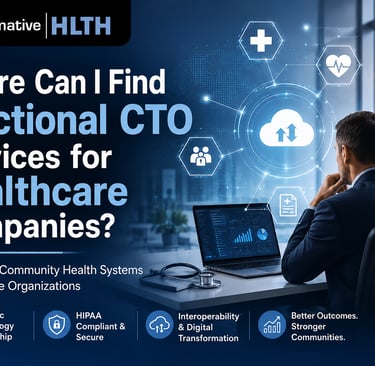
You can find fractional CTO services for healthcare companies through three main paths:
(1) boutique advisory firms that specialize specifically in healthcare technology leadership,
(2) general fractional-executive marketplaces that let you filter by healthcare experience, and
(3) referrals through healthcare associations, health IT peer networks, and existing vendors like your EHR or interoperability partners. For community health systems and mid-sized healthcare organizations, a healthcare-specialized fractional CTO firm is usually the strongest fit, because generalist fractional-CTO platforms rarely have deep bench strength in HIPAA compliance, interoperability standards, and clinical workflow realities.
If you're a healthcare organization leadership team searching for this, you're probably facing one of two situations: you need senior technology leadership but can't justify (or can't yet fill) a full-time CTO role, or your current technology strategy isn't keeping pace with operational and patient-experience demands. Either way, here's a practical breakdown of where to look, how to vet candidates, and what to watch out for.
What Is a Fractional CTO, and Why Do Healthcare Organizations Use Them?
A fractional CTO is an experienced technology executive who works with your organization part-time or on a defined engagement basis — providing the strategic leadership of a full-time CTO without the cost, recruiting timeline, or long-term commitment of a permanent hire.
For community health systems and mid-sized healthcare providers specifically, fractional CTOs are increasingly common because:
Full-time CTO salaries and benefits are difficult to justify for organizations below a certain size or budget
Digital transformation projects (EHR optimization, interoperability, telehealth, cloud migration) are often time-boxed rather than ongoing needs
Healthcare technology leadership requires a specific blend of clinical workflow understanding, regulatory knowledge (HIPAA, HITECH, interoperability rules), and vendor-management experience that's hard to find and expensive to hire full-time
Boards and leadership teams want senior technology judgment on strategic decisions without expanding permanent headcount
Where to Actually Find Fractional CTO Services for Healthcare
1. Healthcare-Specialized Fractional Executive Firms
This is the most direct path, and generally the strongest fit for healthcare organizations specifically. These firms focus exclusively (or primarily) on healthcare technology leadership, meaning their consultants already understand:
Interoperability standards (HL7, FHIR)
HIPAA and healthcare data governance
EHR ecosystems and clinical workflow constraints
Community health funding and operational cost pressures specific to the sector
Firms like TransformativeHLTH fall into this category — providing fractional CTO services built specifically around community health systems, focused on operational efficiency, patient engagement, and digital transformation strategy rather than generic IT consulting.
2. General Fractional-Executive Marketplaces
Broader platforms connect companies with fractional executives across functions (CFO, CTO, CMO, etc.), usually filterable by industry. These can work for straightforward technical leadership needs, but healthcare-specific depth varies widely — vet carefully for actual healthcare vertical experience, not just general technology leadership.
3. Referrals Through Healthcare Networks and Associations
Health IT associations, regional healthcare coalitions, EHR vendor partner networks, and peer CIO/CTO groups are strong sources of vetted referrals. A fractional CTO who's worked with a peer organization similar to yours — same EHR platform, similar patient population, similar funding model — often ramps up faster than one without sector-specific context.
4. Your Existing Technology Vendors
EHR vendors, healthcare IT consultancies, and interoperability partners frequently maintain networks of fractional leaders they've worked alongside. This path comes with a caveat: verify independence, since a vendor referral can sometimes lean toward recommendations that favor that vendor's own product roadmap over your organization's actual needs.
How to Vet a Fractional CTO for Healthcare: A Checklist
Healthcare-specific track record. Ask for examples of past engagements with organizations similar in size, funding model, and patient population to yours.
Regulatory fluency. Confirm real working knowledge of HIPAA, HITECH, and interoperability requirements — not just general cybersecurity awareness.
Engagement model clarity. Understand exactly what's included: hours per week/month, strategic vs. hands-on scope, and how decisions get escalated.
References you can actually call. Ask specifically about the outcome of their last engagement, not just tenure or title.
Clear off-ramp. A good fractional engagement should have a defined path to either extend, convert to a different scope, or transition to a full-time hire if needed — not an open-ended retainer with no milestones.
Cultural and communication fit. Especially for community health organizations, a fractional CTO needs to communicate effectively with clinical staff, boards, and non-technical stakeholders, not just technical teams.
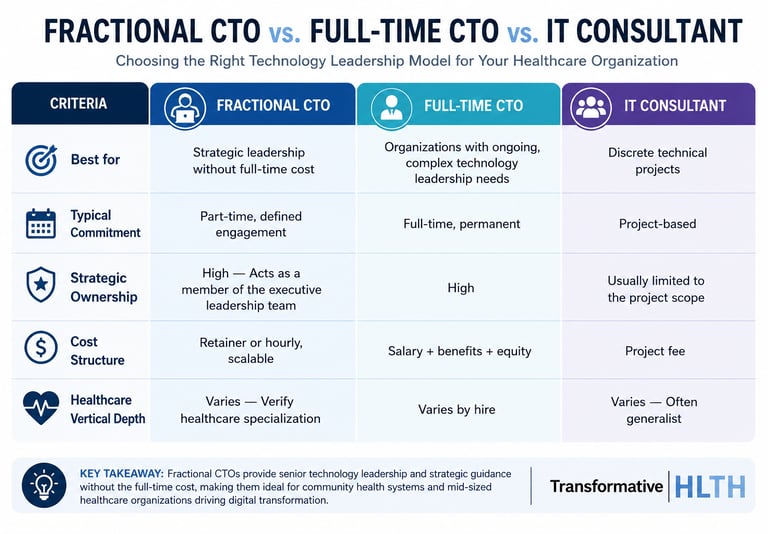
Fractional CTO vs. Full-Time CTO vs. IT Consultant
Red Flags to Watch For
Vague answers about specific healthcare regulatory experience
No clear reporting structure or defined scope of engagement
Reluctance to provide references from comparable healthcare organizations
One-size-fits-all technology recommendations that don't account for your funding model or patient population
Engagements that never define success metrics or a review cadence
Why This Search Itself Has Changed in 2026
It's worth noting: how healthcare leaders search for services like this has shifted. Google's May 2026 core update put renewed weight on content that demonstrates genuine, first-hand expertise — particularly relevant for high-stakes decisions like healthcare technology leadership, where generic listicles don't hold up to scrutiny. At the same time, the June 2026 spam update further filtered out thin, templated "top 10 fractional CTO firms" content that doesn't reflect real vetting or healthcare-specific knowledge.
Practically, that means the search results (and increasingly, AI-generated answers from tools like ChatGPT and Perplexity) that healthcare leaders see when researching "where to find fractional CTO services" are shifting toward more substantive, specialized content — and away from generic aggregator pages. If you're evaluating options, prioritize sources that demonstrate real healthcare-sector depth over broad marketplaces optimized purely for search visibility.
Frequently Asked Questions
1. How much does a fractional CTO for a healthcare company typically cost?
Costs vary widely based on scope, hours, and experience level, typically structured as a monthly retainer or hourly rate rather than a full-time salary. Get a clear scope of engagement before comparing pricing across providers, since "fractional CTO" scope can range from a few strategic hours a month to near-full-time involvement.
2. What size healthcare organization needs a fractional CTO?
Fractional CTOs are most common among community health systems, mid-sized providers, and growing digital health companies that need senior technology leadership but aren't yet at the scale (or budget) to justify a full-time executive hire.
3. How is a fractional CTO different from an IT director?
An IT director typically manages day-to-day technology operations and infrastructure. A fractional CTO operates at a strategic leadership level, shaping technology strategy, vendor decisions, and digital transformation roadmap alongside the executive team and board.
4. Can a fractional CTO help with EHR optimization and interoperability specifically?
Yes, provided they have direct healthcare experience with EHR ecosystems and interoperability standards like HL7 and FHIR — this is exactly the kind of vertical-specific expertise to confirm during vetting, since it varies significantly between generalist and healthcare-specialized providers.
5. How long do fractional CTO engagements typically last?
Engagements range from a few months for a specific initiative (like a digital maturity assessment) to multi-year ongoing strategic partnerships. The key is defining clear milestones and review points regardless of the initial length.
Considering a Fractional CTO for Your Health System?
TransformativeHLTH works specifically with community health systems and healthcare organizations to provide fractional CTO leadership focused on operational efficiency, patient engagement, and digital transformation strategy. Explore our services or get in touch to start with a digital maturity conversation.
Innovation
Empowering health systems through strategic digital transformation solutions.
Support
© 2026. All rights reserved.